TL;DR
- ANYPDF: Highly obfuscated trojan disguised as a PDF viewer, distributed via signed MSI installers.
- GREENBLOOD: Ransomware written in Go with data-theft capabilities.
- DYNOWIPER: Wiper that completely destroys data by overwriting files with pseudorandom bytes, deletes shadow copies, and reboots the system.
1) ANYPDF (Windows)
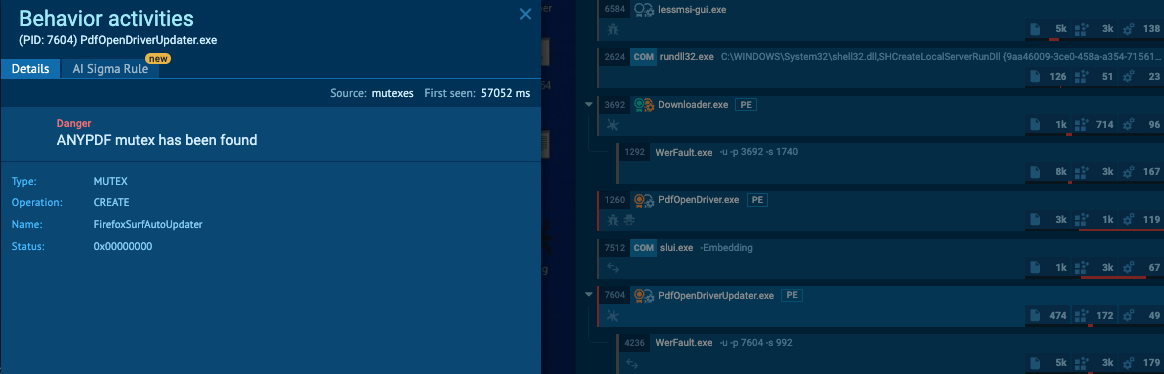
Sample: ANY.RUN
ANYPDF is a highly obfuscated trojan disguised as a legitimate PDF viewer. It spreads through phishing campaigns and targeted attacks. Its primary goal is to steal credentials and intercept sensitive information from browsers and other applications. It is distributed via MSI installers signed with a digital certificate. It uses encryption modules and hidden loading of additional payloads, operating mostly in memory. It establishes persistence through the registry, autorun, and WMI scripts.
How to detect: Monitor cmd.exe executions containing the string ANYPDF and the URL https[:]//peedeef.com/openup/uptime/default, as well as the presence of mutexes FirefoxSurf or FirefoxSurfAutoUpdater.
Key facts:
- DLL Side-Loading via trusted processes.
- Selective Data Exfiltration with encryption of sensitive data.
- Mutex Creation to prevent reinfection.
- Obfuscated Payload and C2 Communication Obfuscation over HTTP/HTTPS.
Analytical note:
| Detected | External sources | ANY.RUN Last Submission | Sandbox Evasion |
|---|---|---|---|
| 2026-01-28 | News | 2026-02-03 | 24 |
Using the following TI Lookup query, you can search recent public sandbox analyses and identify ANYPDF activity.
TI Lookup:
syncObjectName:"FirefoxSurf" OR syncObjectName:"FirefoxSurfAutoUpdater" OR commandLine:"ANYPDF https://peedeef.com/openup/uptime/default"
IOCs:
- SHA256:
ea09fb40963340b212833e796f229ff52e80c66c4354fbe1107cecc07d3c988a - SHA256:
ad8322170e39cb1ace157e0bb0bbffd71cf7e11f602c29f273109acc7329b579 - SHA256:
3e4c6a39e2302ee42a1d51ce6093d8325839581ff8b4ad77ce12d2e9326fc839 - SHA256:
614104efb1c80099594f09c788b9ea5e03b65fa0405d60863baaa4b9dae20935 - Domain:
ANYPDF.com - Domain:
anyprx.com - Domain:
peedeef.com
MITRE:
| Technique ID | Technique Name | Evidence |
|---|---|---|
| T1562.004 | Impair Defenses: Disable or Modify System Firewall | Commands to disable/modify Windows Firewall to allow C2 traffic. |
| T1574.002 | Hijack Execution Flow: DLL Side-Loading | Loading of malicious DLL via trusted processes. |
| T1027 | Obfuscated Files or Information | Encryption and obfuscation of components, decrypted only at runtime. |
| T1056.001 | Input Capture: Keylogging | Built-in keylogger for capturing passwords and other information. |
| T1071.001 | Application Layer Protocol: Web Protocols | HTTP/HTTPS for hidden data transmission to C2. |
| T1105 | Ingress Tool Transfer | Download of additional components via HTTP. |
| T1555.003 | Steal Credentials from Web Browsers | Theft of passwords and session data from browsers. |
| T1204.002 | User Execution: Malicious File | Distribution via fake MSI/EXE installers. |
| T1497.001 | Virtualization/Sandbox Evasion: System Checks | Environment checks for signs of virtualization. |
| T1543.003 | Create or Modify System Process: Windows Service | Installation of the malicious process as a Windows service. |
2) GREENBLOOD (Windows/Go)
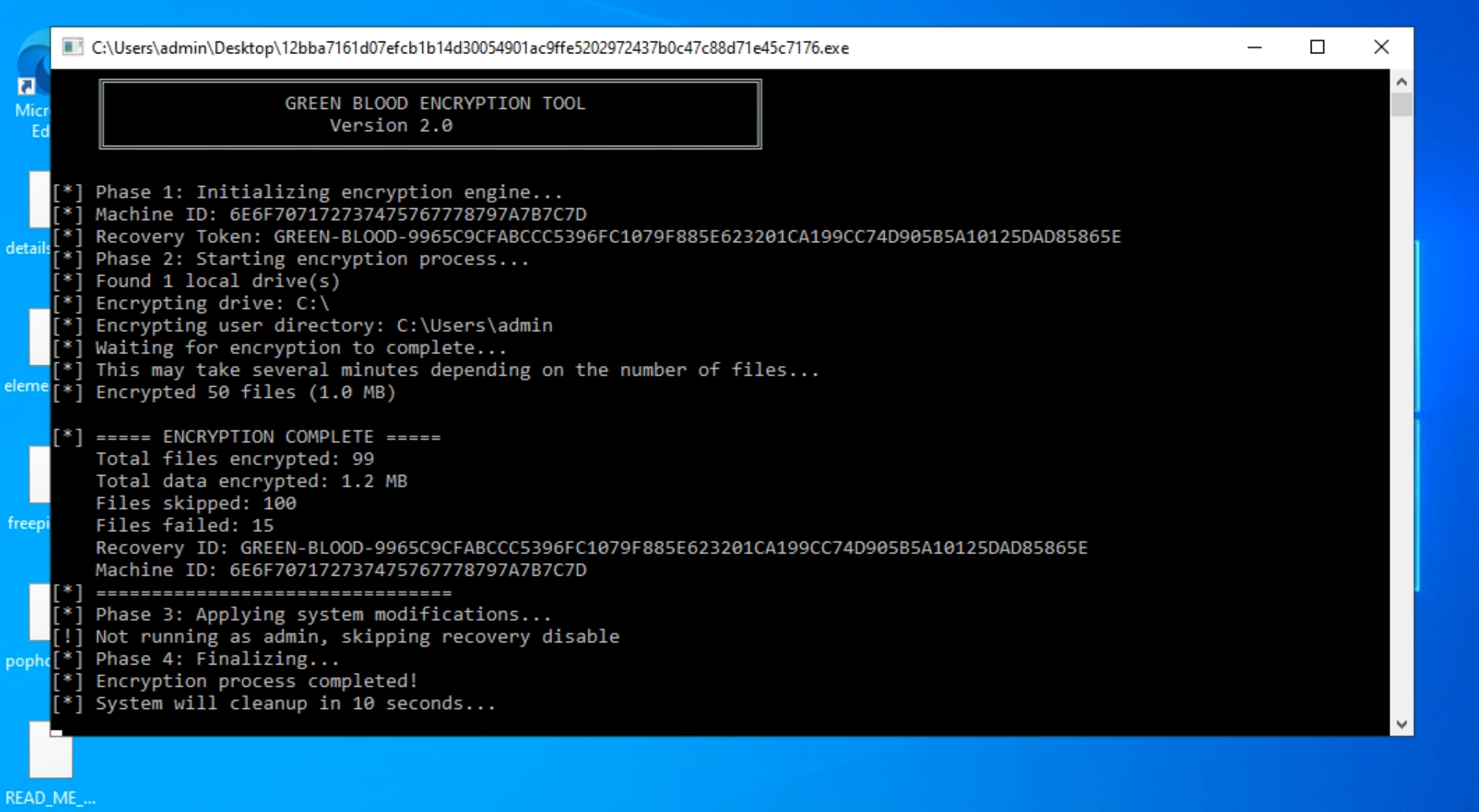
Sample: ANY.RUN
GREENBLOOD is ransomware that has its own leak site. It targets organizations in multiple countries. Written in Go, it has data-theft capabilities for subsequent extortion.
How to detect: Monitor anomalous file and command-line activity containing the string greenblood.
Key facts:
- Ransomware + data-stealing capabilities.
- Written in Go.
- Own leak site.
Analytical note:
| Detected | External sources | ANY.RUN Last Submission | Sandbox Evasion |
|---|---|---|---|
| 2026-02-02 | News | 2026-02-03 | 0 |
Using the following TI Lookup query, you can search recent public sandbox analyses and identify GREENBLOOD activity.
TI Lookup:
commandLine:"greenblood"
IOCs:
- SHA256:
12bba7161d07efcb1b14d30054901ac9ffe5202972437b0c47c88d71e45c7176 - SHA256:
5d234c382e0d8916bccbc5f50c8759e0fa62ac6740ae00f4923d4f2c03967d7a
MITRE:
| Technique ID | Technique Name | Evidence |
|---|---|---|
| T1486 | Data Encrypted for Impact | Encrypts files |
| T1047 | Windows Management Instrumentation | Accesses WMI to obtain product unique identifier |
| T1059 | Command and Scripting Interpreter: Windows Command Shell | Launches CMD.EXE for command execution |
| T1082 | System Information Discovery | Collects system information |
| T1012 | Query Registry | Reads various registry keys |
| T1518 | Software Discovery: Security Software Discovery | Detects installed security software |
3) DYNOWIPER (Windows)
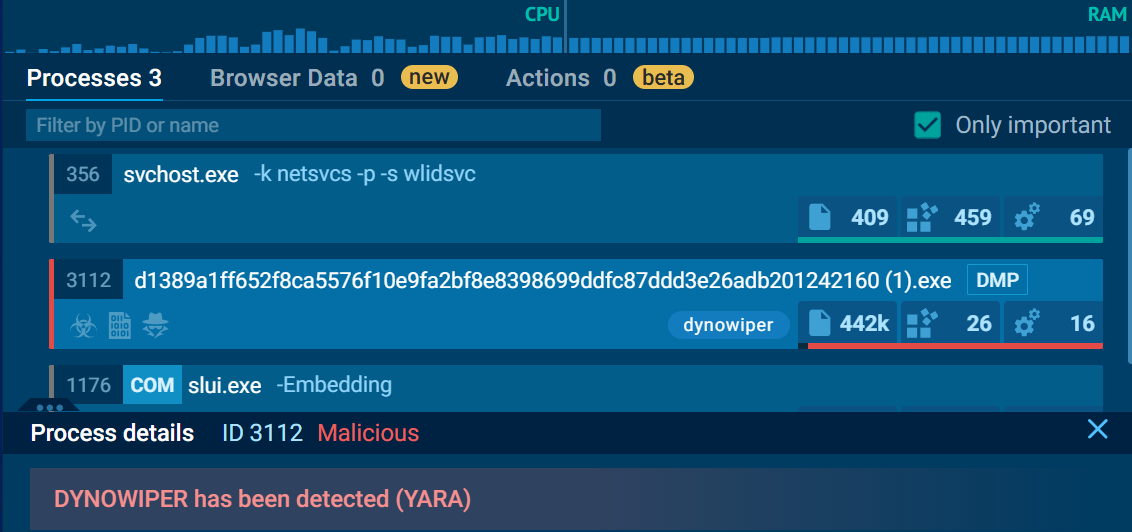
Sample: ANY.RUN
DYNOWIPER is a wiper designed for complete data destruction on infected systems. It overwrites files with pseudorandom data, making recovery practically impossible. It traverses all fixed and removable drives, deletes shadow copies, and reboots the system.
How to detect: Triggering of the DYNOWIPER YARA rule (characteristic random-number-generator signatures and system directory exclusion strings).
Key facts:
- Mass overwriting of files on all drives.
- 16-byte buffer, partial overwriting of large files, complete destruction of small files.
Analytical note:
| Detected | External sources | ANY.RUN Last Submission | Sandbox Evasion |
|---|---|---|---|
| 2026-01-30 | TI | 2026-02-03 | 10 |
Yara
rule DynoWiper
{
    meta:
        date = "2026-02-01"
        author = "ANY.RUN"
        threat = "dynowiper"
        tags = "dynowiper, wiper"
        sample = "https://app.any.run/tasks/0a8c15ef-adc3-42b2-89b3-d11e81afe3f8/"

    strings:
        $random_gen_lcg = { 69 c1 65 89 07 6c 03 c2 42 89 47 fc 81 fa 70 02 00 00 7c e2 }
        /*
           Random Number Generator (LCG)

           imul   ecx,ecx,0x6c078965   ; Multiply by magic number
           add    eax,edx               ; Add to previous value
           mov    [edi-0x4],eax         ; Save random byte
           cmp    edx,0x270            ; Check if 624 bytes done
           jl     <loop>               ; Continue if not finished

           Creates random data using math (0x6c078965 = MS C library constant).
           Generates 624 bytes at a time to overwrite and destroy files.
        */

        $random_tempering = { c1 e8 0b 23 86 ?? ?? 00 00 33 c8 8b c1 25 ad 58 3a ff c1 e0 07 }
        /*
           Random Quality Improvement (Mersenne Twister)

           shr    eax,0xb              ; Shift right 11 bits
           and    eax,[esi+offset]     ; Apply mask
           xor    ecx,eax               ; Mix with XOR
           mov    eax,ecx               ; Copy result
           and    eax,0xff3a58ad        ; Apply second mask
           shl    eax,0x7               ; Shift left 7 bits

           Makes random data better quality using bit operations.
           Wiped files become harder to recover because data looks truly random.
        */

        $s1 = "$recycle.bin" fullword wide
        $s2 = "program files(x86)" fullword wide
        $s3 = "perflogs" fullword wide
        $s4 = "windows" fullword wide
        $s5 = "Error opening file: " fullword wide

    condition:
        uint16(0) == 0x5A4D
        and any of ($random*) and all of ($s*)
}
MITRE:
| Technique ID | Technique Name | Evidence |
|---|---|---|
| T1485 | Data Destruction | Overwrites file contents with random data |
| T1490 | Inhibit System Recovery | Deletes shadow copies and restore points |
| T1083 | File and Directory Discovery | Enumerates files and directories on all available drives |
| T1106 | Native API | Uses Windows API for direct file and disk operations |
| T1070.004 | File Deletion | After overwriting, files remain corrupted or are deleted |
| T1529 | System Shutdown/Reboot | Initiates system reboot after completing destructive actions |
Conclusion
1) ANYPDF leaves clear artifacts in the form of specific mutexes FirefoxSurf/FirefoxSurfAutoUpdater and a command line containing the peedeef.com domain — a reliable indicator of presence despite DLL side-loading and obfuscation.
2) GREENBLOOD uses an easily detectable command line with the substring greenblood and leaves characteristic IOCs in the form of two known hashes — sufficient for quick searching in sandboxes and logs.
3) DYNOWIPER reveals itself through characteristic random-data generation algorithms (LCG + Mersenne Twister tempering) and system directory exclusion strings — the YARA rule allows reliable detection of the wiper.