TL;DR
- MIMIC (Windows ransomware): Derived from leaked Conti source code and uses Everything for fast file discovery before encrypting data with ChaCha20. Abuses PowerShell, CMD, services, registry keys, and IFEO hijacking, while disabling Defender, deleting shadow copies, and forcing High Performance mode to speed up encryption and block recovery.
- CrystalX (Windows RAT): Combines remote access features with prankware-style visual effects and disguises its persistence as NVIDIA-like scheduled tasks. Uses mutexes and scheduled tasks for anti-relaunch and persistence, while maintaining C2-based remote control.
- Trojanized Telnyx Package: A supply-chain compromise in the Telnyx Python SDK where unauthorized PyPI releases executed malicious code on import. The malicious package used WAV-based payload delivery, dropped persistence on Windows, and exfiltrated credentials through HTTP.
1) MIMIC (Windows)
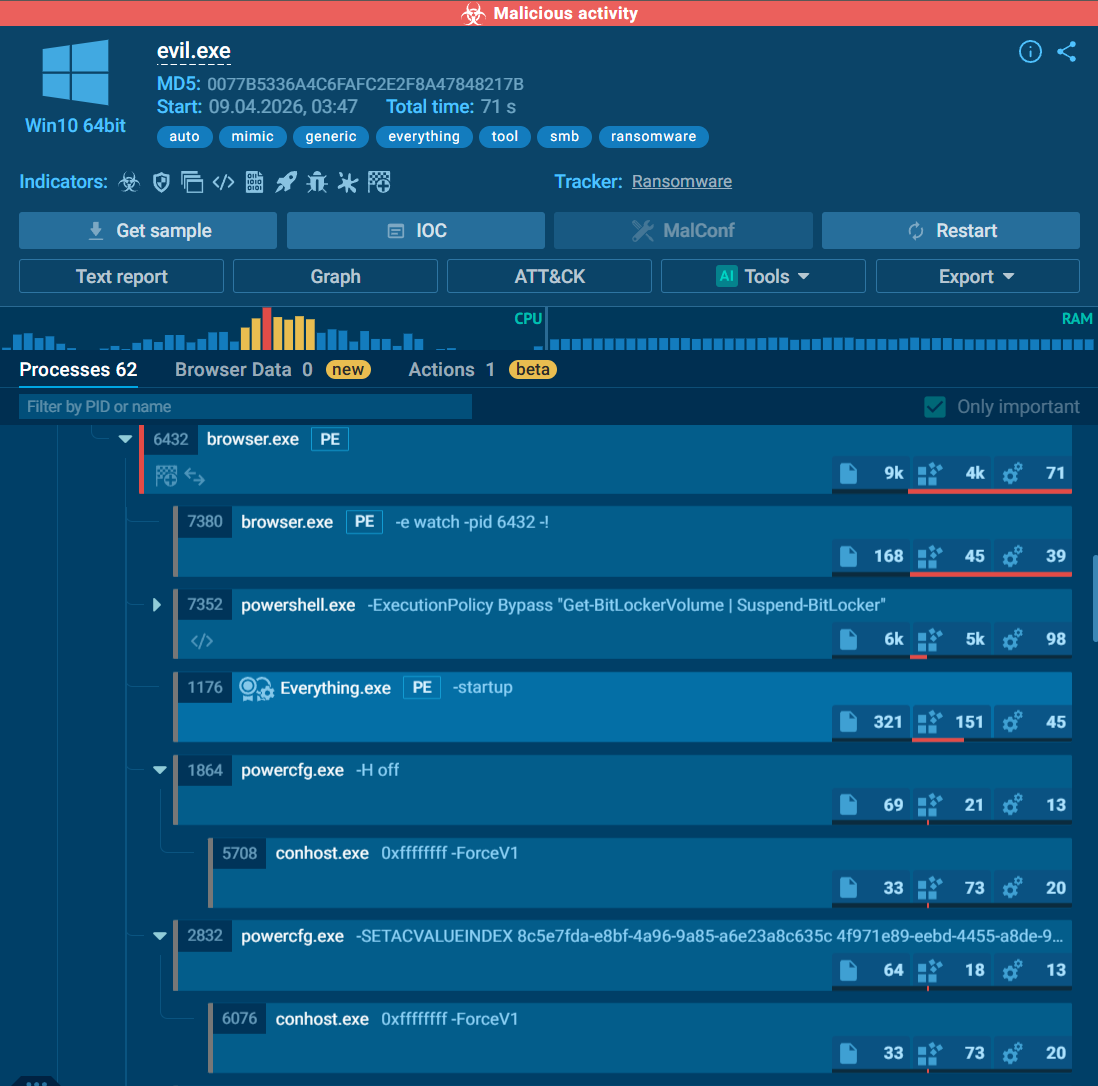
Sample: ANY.RUN
MIMIC is a ransomware strain derived from leaked Conti source code. It leverages the legitimate Everything utility API for rapid file searches and uses ChaCha20 for encryption. The malware actively cripples system recovery by deleting VSS shadows, disabling Windows Defender, and modifying system power settings to maximize data destruction speed.
How to detect: Detected by monitoring abnormal file and command-line activities and mutexes.
Key facts:
- Everything integration for fast target file discovery.
- Conti-based core with ChaCha20 + ECDH encryption.
- Defense evasion by disabling Windows Defender via PowerShell and terminating 50+ security, database, and related services.
- High-Performance mode is forced through Windows power plan changes to maximize encryption speed and prevent hibernation or reboot.
- Anti-recovery behavior includes deleting shadow copies, system backups, and disabling automated repair.
- LotL tactics rely on legitimate third-party binaries to bypass static analysis and EDR detection.
Analytical note:
| Detected | External sources | ANY.RUN Last Submission | Sandbox Evasion | VT First Submission |
|---|---|---|---|---|
| 2026-04-08 | - | 2026-04-09 | 0 | 2026-04-08 |
With the following TI Lookup query, we can search through recent public sandbox analyses and identify this malicious activity.
TI Lookup:
filePath:".a2290u_p2k$"
IOCs:
- SHA256:
5a4be7cb16147df1b37015d912183431e3fc98c0d7b52d736849d1fea93f5ac5
MITRE:
| Technique ID | Technique Name | Evidence |
|---|---|---|
| T1059.001 | Command and Scripting Interpreter: PowerShell | Starts POWERSHELL.EXE for commands execution. |
| T1059.003 | Command and Scripting Interpreter: Windows Command Shell | Starts CMD.EXE for commands execution. |
| T1569.002 | System Services: Service Execution | Starts NET.EXE for service management. |
| T1543.003 | Create or Modify System Process: Windows Service | Creates or modifies Windows service. |
| T1546.012 | Event Triggered Execution: Image File Execution Options Injection | Modifies IFEO debugger key to hijack process execution. |
| T1547.001 | Boot or Logon Autostart Execution: Registry Run Keys / Startup Folder | Changes the autorun value in the registry. |
| T1112 | Modify Registry | Modifies different registry values. |
| T1562.001 | Impair Defenses: Disable or Modify Tools | Changes Windows Defender settings. |
| T1012 | Query Registry | Reads different registries. |
| T1082 | System Information Discovery | Reads different system data. |
| T1518.001 | Software Discovery: Security Software Discovery | Enumerates installed security software. |
| T1486 | Data Encrypted for Impact | Encrypts files for impact. |
| T1490 | Inhibit System Recovery | Deletes shadow copies or disables system recovery. |
2) CrystalX (Windows)
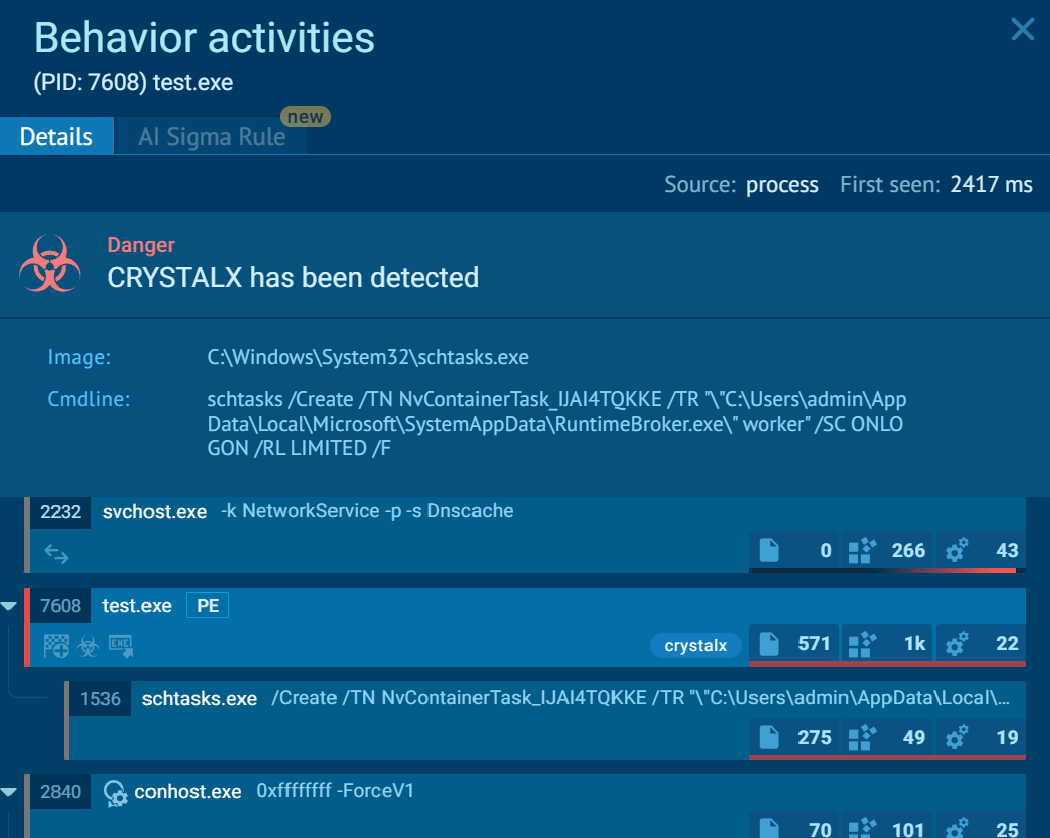
Sample: ANY.RUN
CrystalX is a RAT with elements of prankware, combining classic remote administration features with visible and distracting effects on the victim system. It allows the operator to control the system, execute commands, and collect data while also displaying visual or disruptive effects, which makes it different from typical silent RAT tooling.
How to detect: Detected by mutex artifacts and scheduled-task creation, especially Global\WinSecMutex_*, Global\RtSyncMutex_*, and NvContainerTask_*.
Key facts:
- Combines RAT functionality and prankware effects.
- Allows remote command execution and system control.
- Uses mutex objects to prevent repeated execution.
- Persists through scheduled tasks masked as legitimate tasks.
- Can display visual or destructive effects to the user.
- Masquerades as system or NVIDIA-like tasks.
Analytical note:
| Detected | External sources | ANY.RUN Last Submission | Sandbox Evasion | VT First Submission |
|---|---|---|---|---|
| 2026-04-01 | securelist.com | 2026-04-07 | 14 | 2026-04-03 |
With the following TI Lookup query, we can search through recent public sandbox analyses and identify this malicious activity.
TI Lookup:
syncObjectName:"Global\\WinSecMutex_" OR syncObjectName:"Global\\RtSyncMutex_" OR commandLine:"schtasks /Create /TN NvContainerTask_*"
IOCs:
- Mutex:
Global\WinSecMutex_* - Mutex:
Global\RtSyncMutex_* - Scheduled task:
NvContainerTask_*
MITRE:
| Technique ID | Technique Name | Evidence |
|---|---|---|
| T1053.005 | Scheduled Task | Creates tasks NvContainerTask_* for persistence. |
| T1059 | Command and Scripting Interpreter | Executes attacker commands on infected host. |
| T1105 | Ingress Tool Transfer | Receives commands/modules from C2. |
| T1027 | Obfuscated/Hidden Artifacts | Uses randomized mutex and task names. |
| T1491 | Defacement / Impact | Displays prank or visual effects on the victim system. |
| T1071 | Application Layer Protocol | Communicates with C2 for remote control. |
3) Trojanized Telnyx Package (Win/Mac/Linux)
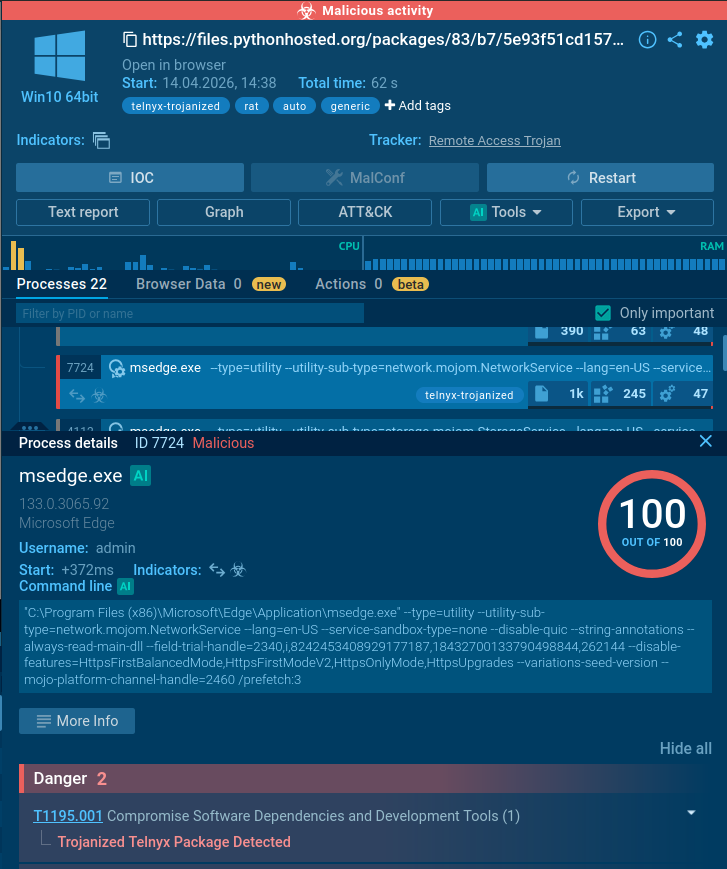
Sample: ANY.RUN
Trojanized Telnyx Package is a supply-chain compromise where the Telnyx Python SDK was briefly trojanized on PyPI. Two unauthorized releases, 4.87.1 and 4.87.2, were published and contained malicious code, while the upstream platform, APIs, and infrastructure were not compromised. The compromised versions were removed the same day.
How to detect: Detection based on identifying malicious package versions, import-triggered activity, and runtime communication with the observed C2 infrastructure 83.142.209[.]203:8080.
Key facts:
- The malicious releases were
telnyx==4.87.1andtelnyx==4.87.2; both were unauthorized PyPI publishes and both contained injected code intelnyx/_client.py. - The payload executes automatically on
import telnyx, so no explicit function call is required. - The attacker iterated quickly:
4.87.1contained a casing bug that broke one execution path, while4.87.2fixed it. - The Windows branch drops a persistent executable named
msbuild.exeinto the Startup folder. - The Linux/macOS branch harvests credentials, encrypts them, and exfiltrates them over HTTP POST.
- The malicious code uses WAV steganography as a delivery mechanism: it fetches audio files from attacker infrastructure, decodes a payload using base64 plus XOR, and executes it.
- Observed infrastructure included
83.142.209[.]203:8080, payload paths such as/ringtone.wavand/hangup.wav, and the exfiltration headerX-Filename: tpcp.tar.gz.
Analytical note:
| Detected | External sources | ANY.RUN Last Submission | Sandbox Evasion | VT First Submission |
|---|---|---|---|---|
| 2026-04-02 | telnyx.com | 2026-04-02 | 6 | 2026-04-02 |
With the following TI Lookup query, we can search through recent public sandbox analyses and identify this malicious activity.
TI Lookup:
sha256:"7321caa303fe96ded0492c747d2f353c4f7d17185656fe292ab0a59e2bd0b8d9" or sha256:"cd08115806662469bbedec4b03f8427b97c8a4b3bc1442dc18b72b4e19395fe3" or sha256:"23b1ec58649170650110ecad96e5a9490d98146e105226a16d898fbe108139e5" or sha256:"ab4c4aebb52027bf3d2f6b2dcef593a1a2cff415774ea4711f7d6e0aa1451d4e"
IOCs:
- SHA256:
7321caa303fe96ded0492c747d2f353c4f7d17185656fe292ab0a59e2bd0b8d9 - SHA256:
cd08115806662469bbedec4b03f8427b97c8a4b3bc1442dc18b72b4e19395fe3 - SHA256:
23b1ec58649170650110ecad96e5a9490d98146e105226a16d898fbe108139e5 - SHA256:
ab4c4aebb52027bf3d2f6b2dcef593a1a2cff415774ea4711f7d6e0aa1451d4e - IP:
83.142.209.203:8080
MITRE:
| Technique ID | Technique Name | Evidence |
|---|---|---|
| T1195.001 | Supply Chain Compromise: Compromise Software Dependencies and Development Tools | Malicious versions were published to PyPI under the legitimate package name. |
| T1059.006 | Command and Scripting Interpreter: Python | Malicious code is injected into a Python SDK and executes on import telnyx. |
| T1105 | Ingress Tool Transfer | The payload downloads a second-stage binary from attacker infrastructure. |
| T1027 | Obfuscated Files or Information | The payload is hidden in WAV audio and decoded with base64 plus XOR. |
| T1547.001 | Boot or Logon Autostart Execution: Registry Run Keys / Startup Folder | Windows branch persists by placing msbuild.exe in the Startup folder. |
| T1041 | Exfiltration Over C2 Channel | Credentials are encrypted and exfiltrated via HTTP POST. |
Conclusion
- MIMIC is most clearly identified by the
Everythingabuse pattern, the.a2290u_p2k$artifact, and its aggressive recovery disruption behavior. - CrystalX is easiest to hunt through its mutex patterns and fake NVIDIA-style scheduled task names.
- Trojanized Telnyx Package stands out as a supply-chain compromise, with the strongest indicators being the unauthorized PyPI versions, import-triggered execution, and the
83.142.209[.]203:8080infrastructure. - Across the three cases, the strongest detection approach is to combine host artifacts, command lines, and persistence behavior with the network and package indicators listed above.