TL;DR
- BlankGrabber (Windows stealer): Python-based information stealer that extracts browser credentials, session cookies, Discord tokens, and crypto wallet keys. Uses PyInstaller packing, Discord/Telegram exfiltration, UAC bypass, Defender tampering, hosts-file poisoning, webcam capture, and anti-analysis checks. Frequently drops secondary payloads such as XWorm.
- SilentStealer (Windows stealer): Modular MaaS stealer focused on Chrome profiles and temporary directories. Uses a JavaScript loader, temporary containers, DLL components, and structured TXT staging files before exfiltration.
- TCLBANKER (Windows banking trojan): Brazilian banking trojan delivered through a trojanized Logitech installer and DLL sideloading. Uses .NET Reactor-protected modules, WPF overlays, anti-analysis checks, Brazil geofencing, and a propagation module for WhatsApp and Outlook.
1) BlankGrabber (Windows)
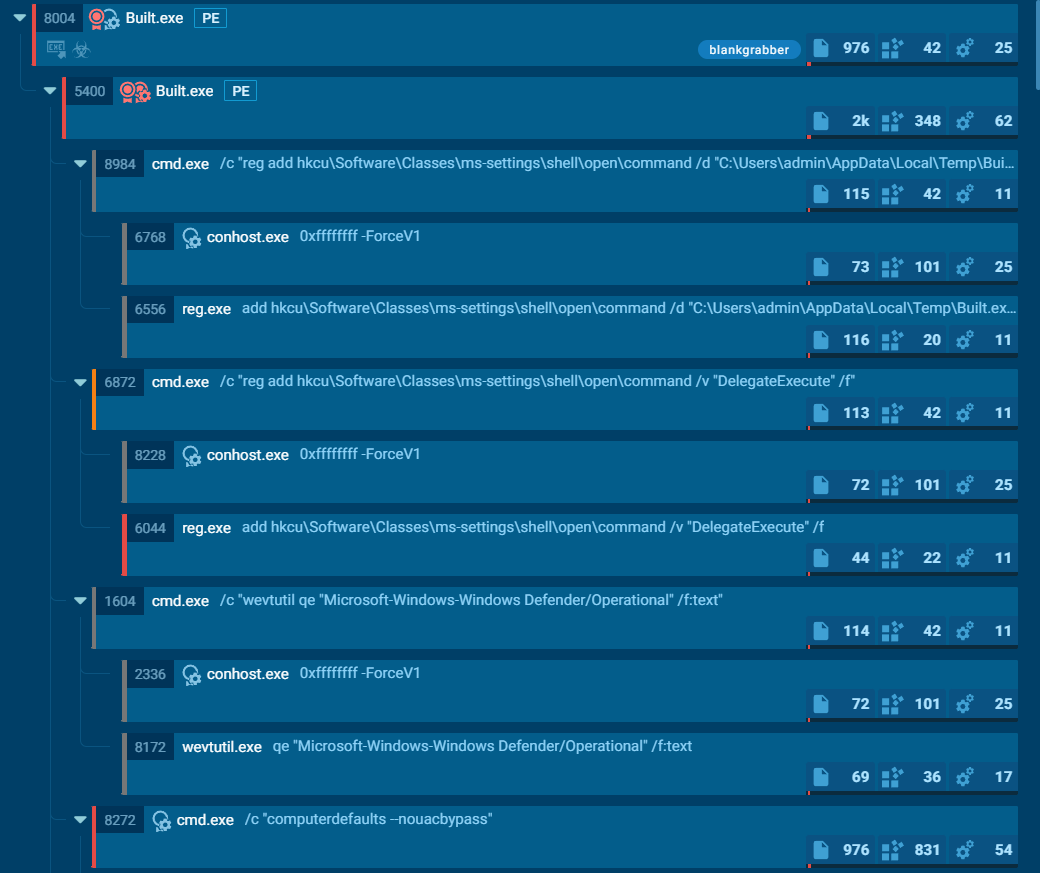
Sample: ANY.RUN
BlankGrabber is a Python-based information-stealing malware designed to exfiltrate highly sensitive data from compromised Windows systems. It can extract saved browser credentials, session cookies, Discord tokens, and cryptocurrency wallet keys, while also capturing screenshots and webcam feeds. Additionally, it uses advanced evasion techniques, attempts UAC bypass for privilege escalation, and frequently drops secondary payloads like XWorm.
How to detect: Detected by monitoring abnormal file activity.
Key facts:
- PyInstaller-packed architecture compiled from pure Python 3 into executable binaries.
- Dual-channel C2 webhooks through Discord webhooks and Telegram bot APIs.
- Multi-app session hijacking across Discord, Steam, Epic Games, Telegram, and Roblox.
- Environment network poisoning through hosts-file changes that block antivirus and security vendor domains.
- Peripheral media capture through desktop screenshots and silent webcam images.
- Anti-analysis and VM checks to terminate when sandboxing or debugging is detected.
- FodHelper UAC bypass for silent privilege escalation.
- Defender-disabling module that uses PowerShell to fully shut down Windows Defender.
- Broad database harvesting from Chromium and Firefox for passwords, autofill histories, Wi-Fi passwords, and local wallets.
Analytical note:
| Detected | External sources | ANY.RUN Last Submission | Sandbox Evasion |
|---|---|---|---|
| 2026-05-26 | - | 2026-05-29 | 3 |
With the following TI Lookup query, we can search through recent public sandbox analyses and identify this malicious activity.
TI Lookup:
filePath:"blank.aes$"
IOCs:
- SHA256:
26e5f82da3e232962066865aacc2c0a54004ec7bd7158a72d3fd804acbaea0c5 - SHA256:
d73a4932409bea4f5d682181400b2d05c7e4bc4e1d0e5776264a3ab3ffe50e8f - SHA256:
e1c87d9fa9d09795b7d3e953b07f4cbe144bccda8dae874da57d963894f4574d - SHA256:
b9e0800fef82feb369fac8261c473bad5090e12e7f21291d67cb807391e6842c - SHA256:
be70cdf524e50b54c230ba80afa7a7afbf307880b070d596a80ff8a1474a7af3 - SHA256:
db84f632e5c3c3b1f99f4be86ca43faf80b3b3cf09002771cdbb9a9c2fc389f8 - SHA256:
de3854330244c80d09d7565dadaf58421691a493bd5b9c7ce2fbd4bdf7b698cf - SHA256:
3e9ae5b03e897614ba8b8497d5f0d8801ac3b3044de59cf8825cac57055d884b - SHA256:
98423d256df39bf8bdf95d426b5ff0a493f245239bf991a00688ffac18c1f00b - SHA256:
ee23ad1049c8ed4da8342ba5433cf61089746918ffa74949faffcf9b28b5477b
MITRE:
| Technique ID | Technique Name | Evidence |
|---|---|---|
| T1047 | Windows Management Instrumentation | Executes commands via WMI for administration or persistence. |
| T1059.001 | Command and Scripting Interpreter: PowerShell | Starts POWERSHELL.EXE for commands execution. |
| T1059.003 | Command and Scripting Interpreter: Windows Command Shell | Starts CMD.EXE for command execution. |
| T1059.006 | Command and Scripting Interpreter: Python | Runs Python interpreter for script execution. |
| T1204.002 | User Execution: Malicious File | Opens a malicious file to execute code. |
| T1112 | Modify Registry | Modifies registry values for persistence or evasion. |
| T1547.001 | Boot or Logon Autostart Execution: Registry Run Keys / Startup Folder | Changes the autorun value in the registry. |
| T1548.002 | Abuse Elevation Control Mechanism: Bypass User Account Control | Bypasses UAC to gain elevated privileges. |
| T1027.004 | Obfuscated Files or Information: Compile After Delivery | Compiles code after delivery to evade detection. |
| T1070.004 | Indicator Removal: File Deletion | Deletes files to remove evidence of compromise. |
| T1222.001 | File and Directory Permissions Modification | Modifies file or directory permissions. |
| T1497.001 | Virtualization/Sandbox Evasion: System Checks | Performs system checks to evade sandbox analysis. |
| T1562.001 | Impair Defenses: Disable or Modify Tools | Disables or modifies security tools such as Defender and AV. |
| T1564.001 | Hide Artifacts: Hidden Files and Directories | Creates hidden files or directories to conceal malicious activity. |
| T1480 | Delay Execution | Delays execution to evade detection or sandbox analysis. |
| T1555.003 | Unsecured Credentials: Credentials In Files | Extracts credentials from files such as config, logs, and registry. |
| T1555.005 | Credentials from Password Stores: Credentials from Web Browsers | Steals saved credentials from web browsers. |
| T1012 | Query Registry | Reads registry keys. |
| T1033 | System Owner/User Discovery | Enumerates system users and owner information. |
| T1049 | System Network Connections Discovery | Lists active network connections. |
| T1057 | Process Discovery | Enumerates running processes. |
| T1082 | System Information Discovery | Reads system data. |
| T1083 | File and Directory Discovery | Enumerates files and directories on the system. |
| T1518.001 | Software Discovery: Security Software Discovery | Enumerates installed security products. |
| T1115 | Clipboard Data | Captures clipboard contents for sensitive information. |
| T1573 | Encrypted Channel | Uses encrypted channel for C2 communication. |
2) SilentStealer (Windows)
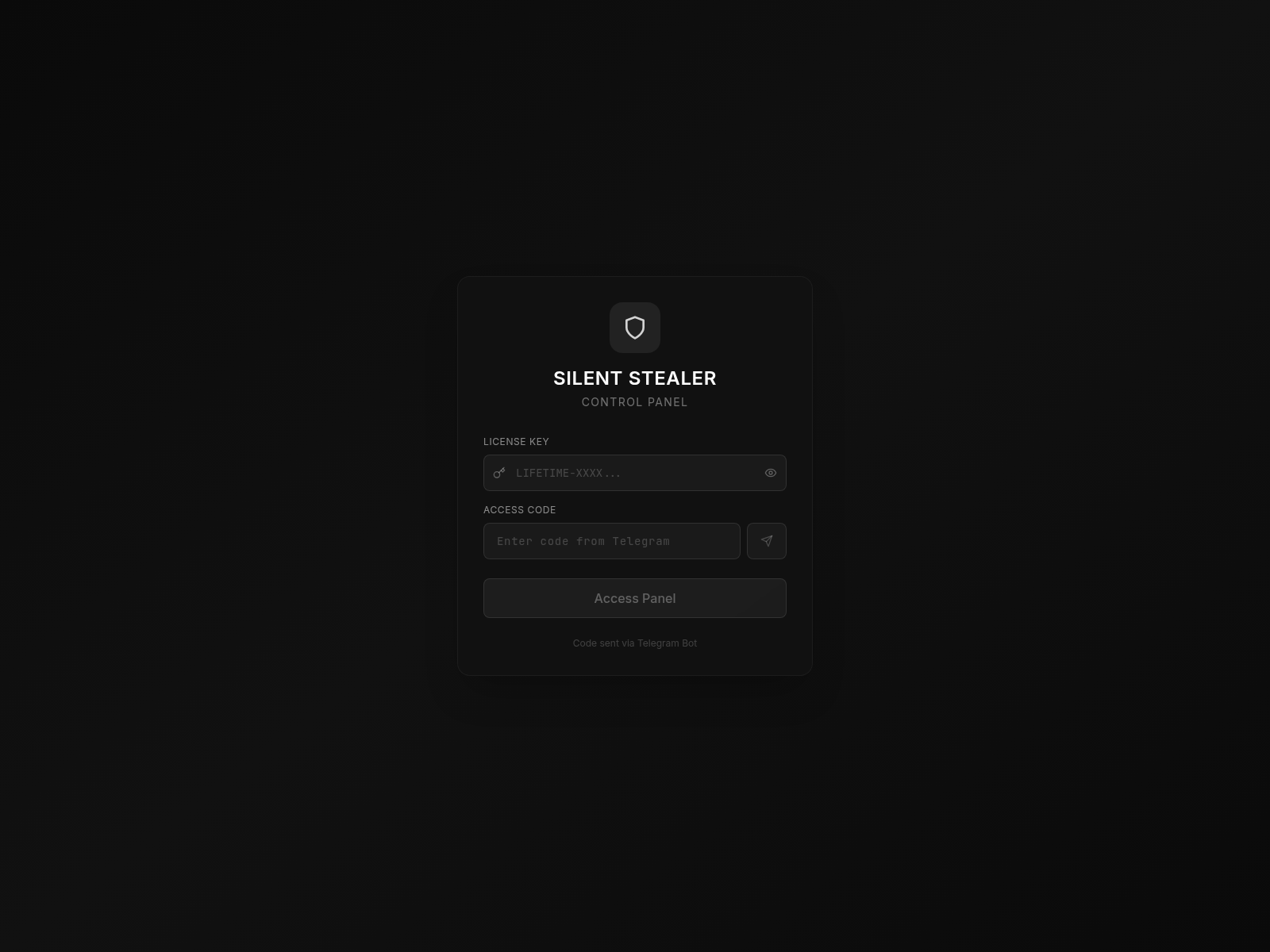
Sample: ANY.RUN
SilentStealer is a modular stealer distributed in MaaS format and focused on mass theft of browser data, session tokens, and locally stored user secrets. Its main focus is automated collection from Chrome profiles and temporary directories, followed by preparation of the data for exfiltration.
The malware uses a multi-stage structure: a JavaScript dropper, intermediate temporary containers, and DLL components to perform the collection logic. The architecture is built around short-lived files and a minimal disk footprint.
How to detect: Detected by file artifacts in Windows user profiles. Detection is based on normalized paths and regex patterns that indicate collection and staging stages.
Key facts:
- MaaS model with a modular delivery structure.
- JavaScript-based loader as the first execution stage.
- Uses DLL components to stealthily extract data.
- Main targets are browser cookies, session tokens, and payment data.
- Uses randomized temporary directories to evade signatures.
- Stores results in structured TXT files before sending them out.
- Possible exfiltration over HTTP/HTTPS C2 channels.
Analytical note:
| Detected | External sources | ANY.RUN Last Submission | Sandbox Evasion |
|---|---|---|---|
| 2026-05-27 | ransom-isac.org | 2026-05-28 | 1 |
With the following TI Lookup query, we can search through recent public sandbox analyses and identify this malicious activity.
TI Lookup:
filePath:"C:\\Users\\*\\AppData\\Local\\Temp\\ck_*\\credit_cards\\no_cards_found.txt" OR filePath:"C:\\Users\\*\\AppData\\Local\\Temp\\ck_*\\BrowserData\\chrome\\cookies.txt" OR filePath:"C:\\Users\\*\\AppData\\Local\\Programs\\*\\script\\crypted.js" OR filePath:"C:\\Users\\*\\AppData\\Local\\Temp\\*.tmp\\SpiderBanner.dll"
IOCs:
ck_<digits>\credit_cards\no_cards_found.txtck_<digits>\BrowserData\chrome\cookies.txtscript\crypted.jsSpiderBanner.dll
MITRE:
| Technique ID | Technique Name | Evidence |
|---|---|---|
| T1005 | Data from Local System | Extraction of local browser and stored user data. |
| T1555.003 | Credentials from Web Browsers | Chrome cookies and session token theft. |
| T1027 | Obfuscated Files or Information | Obfuscated JS loader (crypted.js). |
| T1059.007 | JavaScript | Execution via script-based loader. |
| T1105 | Ingress Tool Transfer | Loading DLL payload (SpiderBanner.dll). |
| T1071.001 | Web Protocols | Communication for data exfiltration. |
| T1566 | Phishing / Initial Access | Likely delivery via malicious package or script. |
| T1041 | Exfiltration Over C2 Channel | Data sent after local aggregation. |
3) TCLBANKER (Windows)
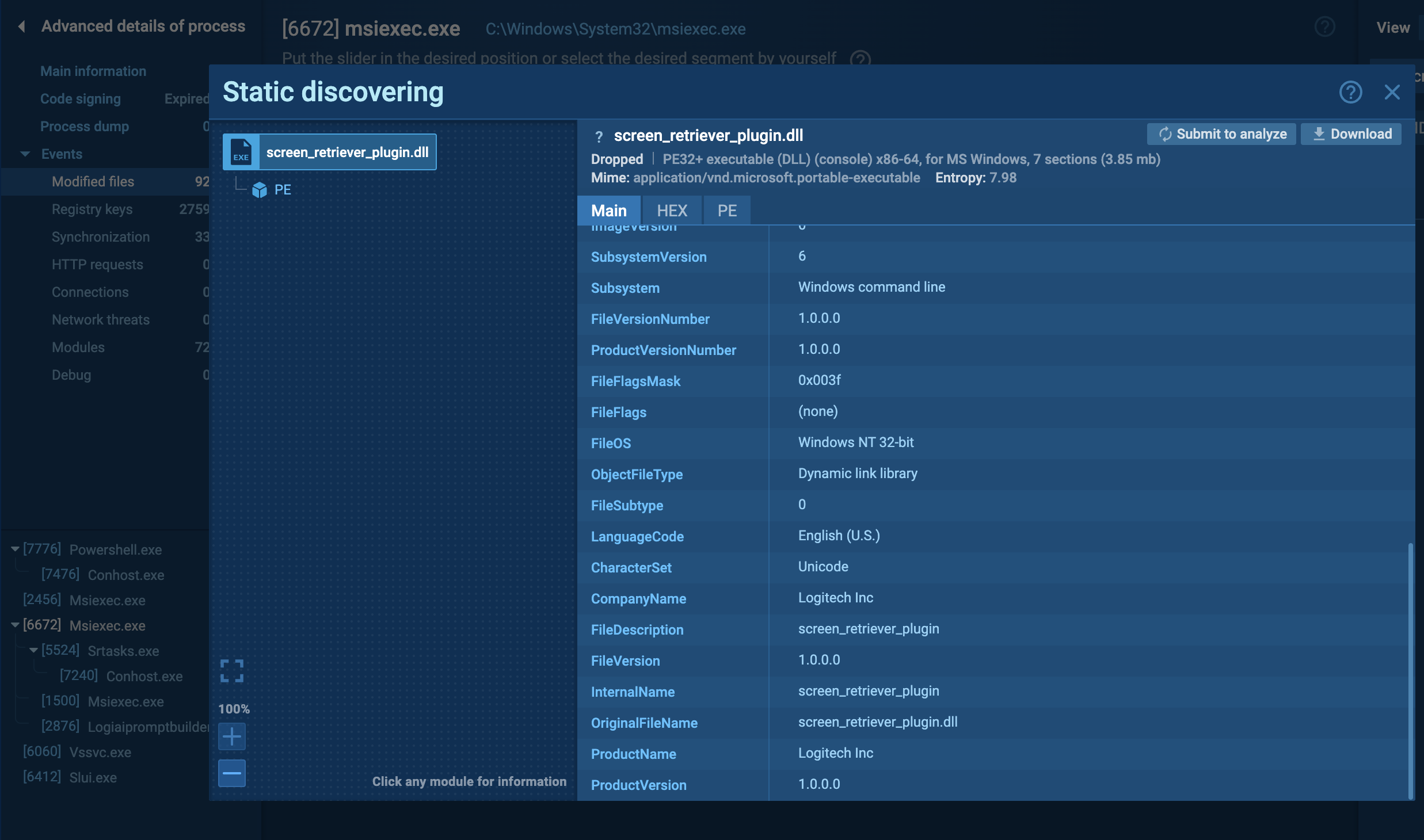
Sample: ANY.RUN
TCLBANKER is a Brazilian banking trojan delivered through a trojanized Logitech installer that abuses DLL sideloading against LogiAiPromptBuilder.exe. The malware campaign uses two embedded .NET Reactor-protected modules: a banking trojan and a self-propagation worm module. The trojan monitors browser activity, targets Brazilian financial, fintech, and cryptocurrency domains, and uses a WPF-based full-screen overlay framework for credential theft and operator-driven social engineering.
How to detect: Detection based on the presence of a sideloaded library whose FileDescription matches screen_retriever_plugin, together with the malicious screen_retriever_plugin.dll loading path.
Key facts:
- Initial intrusion chain uses a trojanized MSI inside a ZIP and abuses a signed Logitech application to load the malicious DLL at startup.
- The DLL is named
screen_retriever_plugin.dlland masquerades as a legitimate Flutter plugin. - Includes anti-debugging, anti-analysis, string encryption, system language checks, ETW patching, and a watchdog subsystem.
- Refuses to run if loaded from analyst-oriented hosts such as
rundll32.exe,regsvr32.exe,dllhost.exe, orsvchost.exe. - Performs Brazil geofencing and collects host context such as OS language and system attributes before proceeding.
- The banking module watches the browser address bar via UI Automation and activates against a set of 59 Brazilian banking, fintech, and cryptocurrency domains.
- A second module handles propagation through WhatsApp and Outlook.
- The campaign infrastructure is hosted on Cloudflare Workers under a single account, with developer artifacts and an incomplete phishing page indicating early-stage activity.
Analytical note:
| Detected | External sources | ANY.RUN Last Submission | Sandbox Evasion |
|---|---|---|---|
| 2026-05-19 | elastic.co | 2026-05-23 | 2 |
With the following TI Lookup query, we can search through recent public sandbox analyses and identify this malicious activity.
TI Lookup:
filePath:"LogiAi\\screen_retriever_plugin.dll"
IOCs:
- SHA256:
701d51b7be8b034c860bf97847bd59a87dca8481c4625328813746964995b626 - SHA256:
8a174aa70a4396547045aef6c69eb0259bae1706880f4375af71085eeb537059 - SHA256:
668f932433a24bbae89d60b24eee4a24808fc741f62c5a3043bb7c9152342f40 - SHA256:
63beb7372098c03baab77e0dfc8e5dca5e0a7420f382708a4df79bed2d900394 - IP:
88.99.125[.]33 - URL:
recebamais[.]com - URL:
campanha1-api.ef971a42.workers[.]dev - URL:
documents.ef971a42.workers[.]dev - URL:
mxtestacionamentos[.]com - URL:
arquivos-omie[.]com - URL:
documentos-online[.]com - URL:
afonsoferragista[.]com - URL:
doccompartilhe[.]com
MITRE:
| Technique ID | Technique Name | Evidence |
|---|---|---|
| T1574.002 | Hijack Execution Flow: DLL Side-Loading | screen_retriever_plugin.dll is sideloaded by LogiAiPromptBuilder.exe. |
| T1036 | Masquerading | The malicious DLL impersonates a legitimate Flutter plugin and abuses trusted application names. |
| T1497.001 | Virtualization/Sandbox Evasion: System Checks | Timing, language, and environment checks are used to avoid analysis. |
| T1053.005 | Scheduled Task/Job: Scheduled Task | Persistence is established through a scheduled task (RuntimeOptimizeService). |
| T1082 | System Information Discovery | The malware collects system and language information before activation. |
| T1566.001 | Phishing: Spearphishing Attachment | Initial delivery is performed through ZIP-distributed malicious installers. |
Conclusion
- BlankGrabber is most clearly identified by its Python/WinAPI hybrid behavior, hosts-file poisoning, and Discord/Telegram exfiltration patterns.
- SilentStealer is easiest to hunt through its short-lived staging files in
Temp, thecrypted.jsloader, andSpiderBanner.dll. - TCLBANKER is most reliably identified by
screen_retriever_plugin.dll, the Logitech sideloading chain, and its Brazilian-targeted overlay banking behavior. - Across all three families, the strongest detection strategy is to combine file artifacts, command lines, persistence behavior, and network indicators from the sections above.